Last Updated on March 26, 2026 by Admin
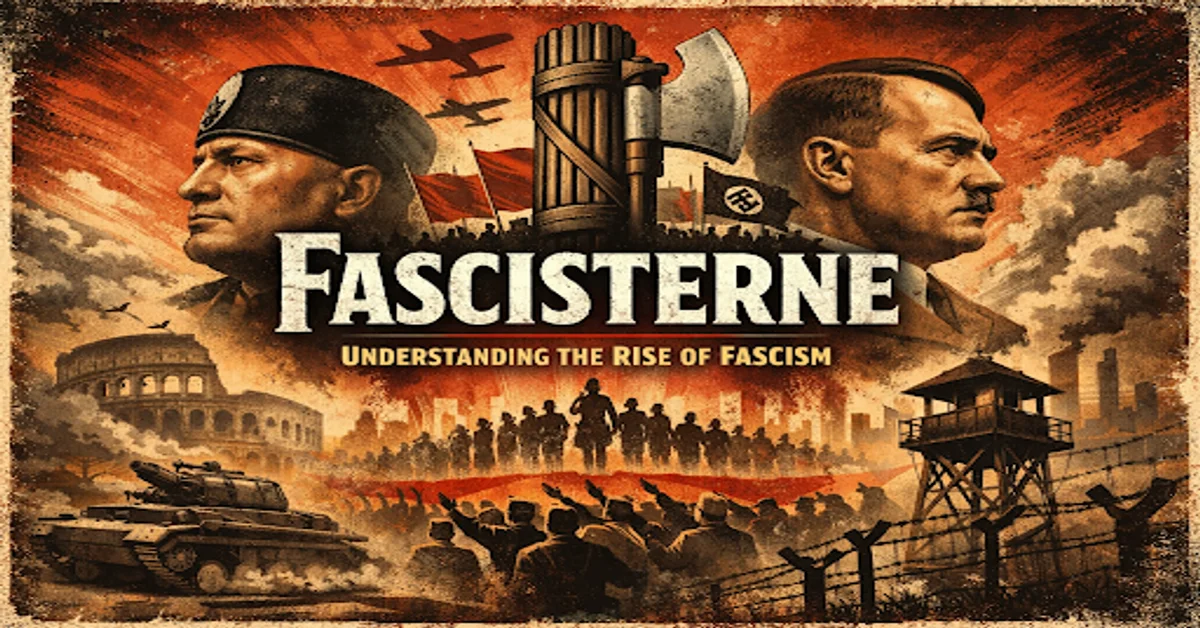
Fascisterne is the Danish definite plural for “the fascists” — a name that points to a broader political phenomenon: organized, authoritarian movements built on extreme nationalism and centralized power. In modern historical study, the term serves as a concise label for groups and supporters who embraced fascism’s methods and goals.
Understanding Fascisterne matters because elements of the ideology — scapegoating, media manipulation, and anti-pluralist rhetoric — can resurface in new political guises. By studying the past with clear, well-documented facts, citizens and institutions can more confidently defend democratic norms and keep societies open and resilient.
Fascism is a far-right political model emphasizing authoritarian leadership, the supremacy of the nation, and the suppression of dissent. It claims to solve crises through unity and strength, often at the cost of civil liberties and minority rights. Examining how such ideas took root historically helps reveal warning signs before they become entrenched.
RELATED: Goutabio: Natural Relief for Gout and Joint Pain
What Does Fascisterne Mean?
Definition of Fascisterne
At its simplest, Fascisterne means “the fascists”: individuals, parties, or supporters who advocate a fascist political program. The term is used in both historical analysis and contemporary critique to identify those aligned with authoritarian nationalism.
Linguistic origin of the word
The Danish form follows grammatical norms that turn a noun into a definite plural, making the term specific and collective. As a linguistic marker, it points to groups rather than abstract theory, which is useful when discussing organized movements and parties.
Difference between Fascisterne and fascism
“Fascism” refers to the ideology and its core doctrines, while Fascisterne denotes the people who promote or enact those doctrines. One is an idea set; the other is a set of social and political actors. Keeping that distinction helps when analyzing motives, methods, and accountability.
Etymology and Historical Origins
Italian roots of the word “fascio.”
The name traces back to the Italian word fascio — a bundle or group — which symbolized unity and strength through togetherness. This imagery was intentionally selected by early movement founders to communicate cohesion and collective purpose.
Symbolism connected to Ancient Rome
Fascist symbolism also borrowed from Roman imagery of authority and unity. Ancient emblems representing civic power were repurposed as modern political brand marks, signaling a claimed continuity with historical strength and order.
Early development of fascist ideology
In the chaotic post-war decades, early fascist thinkers blended national revivalism, anti-leftist rhetoric, and promises of rapid modernization into a potent political package. That cocktail appealed in societies shaken by social and economic disruption, appearing decisive and revitalizing to some citizens.
Rise of Fascisterne After World War I
Political instability after World War I
The years following World War I left many nations battered by losses, fractured politics, and eroded trust in institutions. Citizens hungry for stability sometimes turned to movements promising order and a quick path back to national pride.
Economic crises and social unrest
Widespread unemployment, hyperinflation in certain places, and social polarization created a fertile breeding ground for movements that offered straightforward answers and a strong hand. In this climate, radical solutions — especially those promising unity and national rebirth — became politically potent.
Emergence of fascist movements across Europe
From this turmoil rose movements that emphasized the nation over individual rights, centralized decision-making, and suppression of dissent. These projects presented themselves as the cure to fragmentation and crisis, and thus attracted diverse social groups seeking quick solutions.
Key Leaders Behind Fascisterne Movements
Role of Benito Mussolini in Italy
The Italian movement’s founder engineered a tight, party-led structure and sought visible mass mobilization — rallies, uniforms, and public spectacles — to project authority and cohesion. This top-down model made the movement effective at seizing administrative power and reshaping institutions.
The early consolidation relied on paramilitary intimidation, media influence, and elite accommodation. By co-opting established institutions and eliminating rivals, the movement transformed a crisis rhetoric into durable control over the state apparatus.
Rise of Adolf Hitler in Germany
In the German context, charismatic leadership used propaganda, populist narratives, and organizational skill to capitalize on national humiliation and economic distress. The movement’s disciplined party structure made it ready to convert political gains into systemic control.
Once in position, the leadership moved rapidly to dismantle checks on power. Legal changes, intimidation, and control of the public sphere were used to eliminate pluralism and enforce an exclusionary, hierarchical vision of the nation.
Core Ideology of Fascisterne
Ultranationalism
Ultranationalism is a central pillar: the belief that the nation’s interests trump all other moral or legal constraints. This often includes calls to purify or strengthen the national character and culture.
When combined with state power, ultranationalism leads to discrimination, marginalization, and targeted attacks on perceived outsiders — fueling social division and sometimes state violence.
Authoritarian Leadership
Fascisterne ideology favors a single, decisive authority that claims to act for the national good. Democratic deliberation and institutional checks are cast as weaknesses to be discarded.
Leadership becomes personalized and sacralized, discouraging dissent. The result is political space where criticism is marginal or dangerous, and institutions serve power rather than citizens.
Militarism and War Culture
Military virtues — discipline, sacrifice, and hierarchy — are praised as civic ideals. This framing normalizes force as a political tool and valorizes conflict as a means of national regeneration.
Educational and youth programs can be repurposed to valorize obedience and martial values, shaping generations toward conformity and away from critical civic engagement.
Anti-Communism and Anti-Liberalism
Fascisterne movements positioned themselves as alternatives to both democratic liberalism and leftist class struggle. They promised order by reorganizing society under corporatist or hierarchical frameworks.
This stance justified purges, censorship, and legal suppression of opponents, claiming such measures were necessary to preserve national unity.
Fascisterne in Scandinavia and Denmark
Fascist movements in Denmark
In the 1930s, small movements and parties in Scandinavia mirrored elements of broader European fascism — copying rhetoric, symbols, and tactics. In Denmark, these groups remained marginal but visible, offering a warning that no democracy is immune to extremist pressure.
Influence of the Danish National Socialist Workers’ Party
One local party adopted the visual style and programmatic elements of larger fascist movements and at times, cooperated with occupying powers during conflict. However, these groups generally failed to secure deep popular support and were discredited after wartime collaboration.
Public response to fascist ideology
Denmark’s strong traditions of resistance, civic institutions, and social cohesion helped limit the spread of fascist politics. Acts of rescue and popular resistance during times of occupation showed how democratic cultures can protect vulnerable populations.
Fascisterne During World War II
Expansion of fascist regimes during World War II
During this global catastrophe, several authoritarian regimes pursued expansionist policies rooted in fascist doctrine. Military aggression and territorial ambitions were framed as national destiny, with devastating consequences for millions.
Collaboration and resistance movements
In occupied territories, some local groups collaborated for power or protection, while others organized underground resistance to defend democratic values and aid persecuted communities. These courageous efforts underscore the moral agency of ordinary people in extraordinary times.
Human rights violations and war crimes
State policies targeting minorities and political opponents led to systematic abuses. Postwar responses aimed to hold leaders and perpetrators accountable while establishing legal norms to prevent recurrence.
Social and Cultural Impact of Fascisterne
Suppression of Civil Liberties
Once Fascisterne groups control state power, freedoms of speech, assembly, and press often vanish. Legal systems are reshaped to criminalize dissent, and civil society is weakened by intimidation and law.
Beyond immediate repression, the social fabric suffers. Trust between citizens erodes as surveillance, denunciations, and fear replace open civic life.
Propaganda and Media Control
Propaganda becomes an essential tool: state media, film, and education are repurposed to produce a single narrative. Repetition and spectacle normalize the regime’s message and marginalize alternative viewpoints.
Today, misinformation and algorithmic echo chambers can mimic old propaganda tactics—amplifying divisive narratives and reducing the public’s ability to make informed decisions.
Racial Ideology and Discrimination (Including The Holocaust)
Some fascist programs enshrined racial hierarchies into law and policy, stripping rights and humanity from targeted groups. These policies led to forced displacement, persecution, and systematic violence.
Remembering atrocities — including the catastrophic crimes associated with the Holocaust — is essential to human rights education and the prevention of future genocides. Education fosters empathy and vigilance.
(Note: sensitive topics are described in factual, non-graphic terms to respect victims and readers.)
The Fall of Fascisterne Regimes
Collapse of fascist governments in 1945
Defeats on the battlefield and internal fractures culminated in the collapse of major fascist regimes by 1945. Military reversal exposed the unsustainability of expansionist, violent rule and opened the way for reconstruction.
Legal accountability through the Nuremberg Trials
After the war, international tribunals held key figures to account for war crimes and crimes against humanity. The trials set important precedents: individuals and state leaders can face legal responsibility for large-scale abuses.
Political rebuilding in Europe
Postwar reconstruction emphasized democratic institutions, rule of law, and human rights education — a deliberate response aimed at preventing a recurrence of authoritarianism.
International Response and Legal Safeguards
Creation of global institutions
The postwar era saw the formation of bodies designed to protect peace and human dignity. The establishment of the United Nations codified collective commitments to human rights and international cooperation.
Legal mechanisms to prosecute abuses
To strengthen accountability, international law evolved, and institutions like the International Criminal Court emerged to prosecute atrocities and support justice for victims — though enforcement remains politically complex.
Ongoing challenges
International frameworks provide vital tools, but they work best when backed by resilient domestic institutions and civic engagement. Global norms complement, but do not replace, national safeguards.
Modern Echoes of Fascisterne Ideology
Contemporary far-right movements
While classic fascist regimes were defeated, several modern movements adopt fragments of the ideology—authoritarian language, exclusionary nationalism, and anti-pluralist tactics—without always using historical labels. Recognizing the pattern helps citizens respond intelligently.
Authoritarian political trends
Erosion of press freedom, attacks on the judiciary, and demonization of minority groups are recurring warning signs. Democratic resilience requires active defense: strong institutions, civic education, and an informed electorate.
The role of digital media
Online platforms can accelerate radicalization and organization, making it easier for extremist ideas to spread. Yet the same technologies can support fact-based journalism, civic mobilization, and accountability when responsibly used.
Why Studying Fascisterne Is Important
Lessons for democracy and human rights
Studying Fascisterne equips citizens with the tools to spot rhetorical and institutional threats early. Awareness of tactics—propaganda, scapegoating, institutional capture—enables proactive defense of pluralism.
Educational significance
Holistic education about the past, including ethical discussions and civic literacy, fosters resilience. Teaching history with clarity and empathy builds a culture resistant to hatred and simplistic answers.
Preventing the rise of authoritarian ideologies
Prevention relies on robust institutions, inclusive political discourse, and constant civic vigilance. The past shows that democracies can falter slowly; protecting them requires daily commitment.
Summary
Fascisterne captures the human and political phenomenon of organized fascism — an ideology built on ultranationalism, centralized authority, and suppression of dissent. Historical consequences were catastrophic, and postwar responses sought accountability and renewal.
Remembering the past is not an exercise in blame alone; it is a pragmatic, moral duty. The lessons of Fascisterne teach that democracies require constant care: informed citizens, robust institutions, and a culture of empathy.
Every citizen has a role in defending openness: support independent journalism, insist on rule-of-law norms, and educate younger generations about the values of pluralism. Vigilance, compassion, and informed action are the best safeguards against the return of authoritarian rule.
RELATED: Herbciepscam: How to Spot Herbal Supplement Scams
Frequently Asked Questions
What does Fascisterne mean?
Fascisterne is the Danish term for “the fascists.” It describes people or groups that support or enact fascist ideology, a far-right, authoritarian political system built on ultranationalism, repression of dissent, and strong centralized control.
How did Fascisterne rise in Europe?
Fascisterne grew largely in the aftermath of economic hardship, social dislocation, and political disillusionment following major conflicts. Movements promised stability and revival, using propaganda, paramilitary force, and charismatic leadership to convert unrest into political control.
What were the main beliefs of Fascisterne?
Key beliefs included ultranationalism, glorification of the state and leader, rejection of pluralist democracy, and the use of force to achieve national objectives. They often opposed both liberal democracy and socialist movements.
Did Fascisterne exist in Denmark?
Yes — small fascist and Nazi-inspired groups appeared in Denmark in the 1930s. While they were never broadly accepted, some collaborated during occupation. Danish resistance and postwar reckoning ensured such movements were largely discredited.
Are Fascisterne ideologies still present today?
Elements of fascist ideology — especially exclusionary nationalism and authoritarian tactics — occasionally appear in modern political movements. Recognizing these patterns early and strengthening democratic safeguards are key to preventing their spread.