Last Updated on March 9, 2026 by Admin
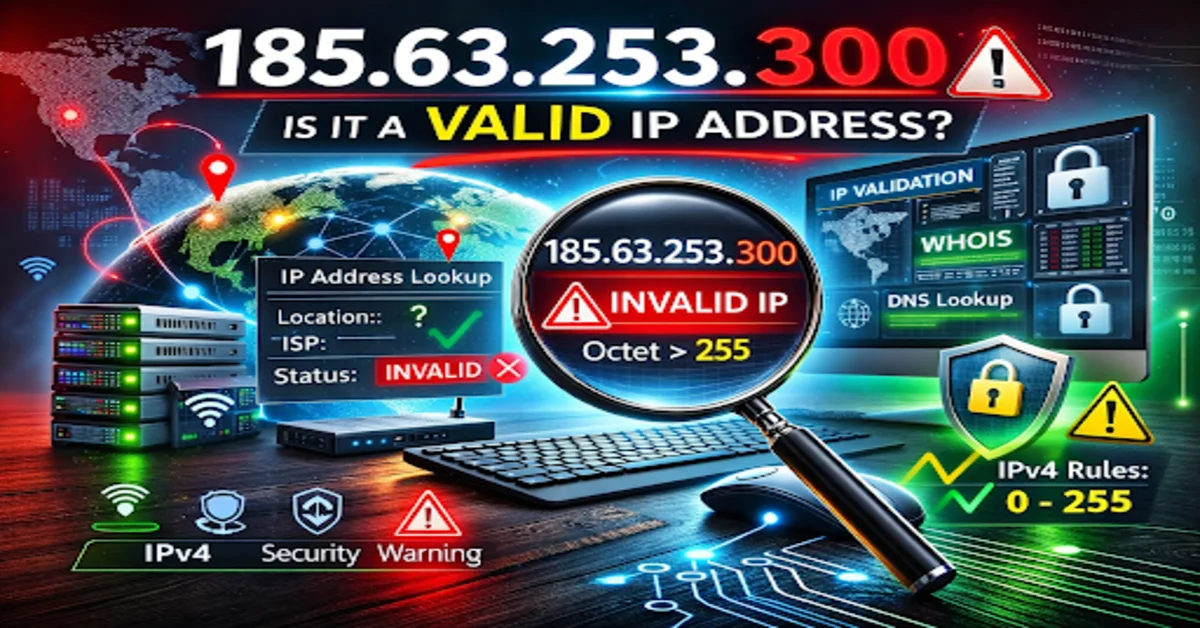
185.63.253.300 appears at first glance to be an IPv4 address — four dot-separated numbers that look like any other IP. But there’s a catch: valid IPv4 octets range from 0 to 255. The “300” at the end makes this value technically invalid. Still, the string can appear in logs, reports, or social chatter, and that’s why it’s worth understanding what it means and how you should treat it in investigations.
People search for weird-looking addresses when they find them in server logs, incoming email headers, firewall alerts, or analytics reports. An odd value like 185.63.253.300 IP address raises curiosity and concern — is it a typo, a malformed log, or evidence of manipulation? This article takes a calm, expert approach: explain why it’s invalid, how to validate addresses (185.63.253.300 IP lookup, 185.63.253.300 whois search), and what steps to take if you encounter suspicious entries like this.
IP address investigation blends simple validation, WHOIS checks, geolocation lookups, blacklist queries (185.63.253.300 blacklist status), and traffic analysis. The goal is to separate harmless errors from real security events. With the right workflow — manual checks plus online IP validation tools — you’ll handle malformed addresses confidently and keep your systems secure.
RELATED: Trucofax: Fast Facts & Trust Guide
Is 185.63.253.300 a Valid IP Address?
Understanding IPv4 structure
An IPv4 address is four octets (numbers) separated by dots: e.g., 185.63.253.30. Each octet is a decimal representation of an 8-bit binary number, so each must be between 0 and 255. This simple rule is the backbone of IPv4 addressing and explains why a last octet of 300 is invalid.
The 0–255 octet rule
Because 8 bits can represent values only from 0 to 255, any decimal value beyond that — like 300 — cannot be represented in a standard IPv4 octet. Network software, parsers, and loggers expect that range; values outside it often trigger validation errors or are normalized by the system in unpredictable ways.
Why 300 makes 185.63.253.300 invalid
When you see 185.63.253.300 IPv4 address spelled out, treat it as malformed. It could be a human typing error (extra digit), a faulty log formatter, or an attempt to obfuscate an IP. Rarely is it a real, routable IP. The appropriate response is validation: check the raw source, correct or discard it as needed, and then run legitimate IP lookup tools only on valid addresses.
Common IP formatting mistakes
Common errors include extra digits, missing dots, accidental characters, or concatenated fields (e.g., timestamp appended). Many network admins resolve these by tracing the log source, re-parsing the raw message, or upgrading parsing libraries to better error-handle malformed inputs.
How IPv4 Addresses Work
What is IPv4?
IPv4 (Internet Protocol version 4) is the foundational addressing scheme of the internet, using 32-bit addresses displayed as four decimal octets. Though IPv6 adoption is increasing, IPv4 remains pervasive. Understanding its constraints (like octet limits) is essential when analyzing entries such as 185.63.253.300 network information.
Role of Internet Assigned Numbers Authority
Internet Assigned Numbers Authority plays a central role in coordinating global IP allocation. It oversees the highest-level assignments and policies that regional registries implement. When you’re doing WHOIS or allocation checks, IANA’s guidelines determine how addresses are distributed.
How ICANN manages internet resources
ICANN, the global domain and addressing coordination body, ensures that naming and addressing systems operate consistently across the internet. While IANA handles the technical allocation, ICANN’s policy frameworks influence how resources are governed across registries and registrars.
Regional IP allocation (RIPE NCC, ARIN)
Regional registries like RIPE NCC and ARIN allocate ranges to ISPs and organizations. Using those WHOIS databases is a standard step in an IP lookup workflow to discover ownership and contact details — useful when investigating entries like 185.63.253.300 whois search results (for valid IPs).
Breaking Down 185.63.253.300 Digit by Digit
First octet analysis (185)
The first octet often gives a rough idea of address class and allocation era. An octet of 185 is commonly seen in modern public IPv4 ranges assigned to European or international hosting providers. If the first three octets were valid, tools like reverse DNS or WHOIS usually reveal the owning network and hosting provider.
Second octet analysis (63)
The second octet refines the network block. Together with the first three octets, it points to specific subnets or customer allocations. For a real address like 185.63.253.x, a lookup might indicate the ISP or hosting company that controls that block.
Third octet analysis (253)
A third octet of 253 usually indicates a high-numbered subnet within a larger allocation. It’s common in blocks assigned for hosting farms, CDN nodes, or large ISPs.
Why the fourth octet (300) is problematic
The fourth octet should be in 0–255. With 300, the entry violates IPv4 rules. Parsers encountering it may truncate, wrap, or throw a validation error. Don’t feed malformed values into lookup tools; first correct or extract the intended value.
Technical explanation of binary limits
Each octet maps to 8 bits. Binary 11111111 equals decimal 255; there’s no representation for 300 within 8 bits. This binary limit is the precise reason for the 0–255 rule and why malformed IPs must be rejected or fixed before investigation.
What Happens When an IP Exceeds 255?
Binary representation of IPv4
IPv4 uses 32 bits total. Exceeding 255 in an octet means the binary pattern demands more than 8 bits. Systems that strictly enforce format will reject such addresses outright, while permissive systems might attempt some transformation.
Decimal-to-binary limits
A value like 300 in decimal is 100101100 in binary — 9 bits — so it cannot fit in a single octet. When software tries to parse this, it either returns an error, truncates the value, or sometimes interprets it differently (e.g., modulo operations), producing unexpected results.
System error messages you may encounter
Typical responses include “Invalid IP address format,” “Malformed address,” or parsing exceptions. Application logs, firewall rules, and monitoring tools will often flag these entries as errors — a useful early warning to inspect log integrity.
Server rejection behavior
Servers and network devices generally drop or ignore malformed source addresses in packets or logs. When storing such data, well-designed logging systems sanitize inputs, while older systems may record the bad string verbatim — which is why you may see 185.63.253.300 in raw logs.
How to Validate an IP Address Correctly
Manual validation method
A manual check is the simplest: verify that the string is four numeric fields separated by dots and that each number is between 0 and 255. For quick checks, mental math or a small script can quickly validate thousands of entries in logs.
Online IP validation tools
Many web tools validate IPs, perform WHOIS lookups, and provide geolocation. Always paste only valid addresses into these tools; malformed inputs may be rejected or produce unreliable results. Validating first prevents wasted effort on invalid queries (e.g., running 185.63.253.300 IP lookup will fail).
WHOIS lookup process
WHOIS queries reveal who holds a valid IP block, administrative contacts, and registration dates. For legitimate IPs you’ll often find the ISP name, abuse contact, and range information — key data for incident response or spam reports.
Reverse DNS lookup explained
Reverse DNS maps an IP address back to a hostname. It’s useful for attributing traffic to hosting providers or specific servers. Reverse DNS will not resolve malformed addresses; however, once you correct an IP, this step helps confirm server ownership and identity.
IP Lookup & Geolocation Explained
What is IP geolocation?
IP geolocation estimates the physical location of an IP address. It’s not exact — it maps to ISP nodes, data centers, or regional proxies. Geolocation tools are useful for identifying likely hosting locations (185.63.253.300 server location would be impossible to geolocate until corrected to a valid IP).
How hosting companies like Cloudflare manage IP routing
Cloudflare and similar edge providers manage large IP blocks and route traffic through CDNs and DDoS mitigation layers. Knowing whether traffic originates from such services can explain obfuscated or transient IPs in your logs.
Using IP tracking tools
IP trackers combine WHOIS, rDNS, geolocation, and blacklist checks to give a full picture of an IP’s reputation. Use them on valid addresses to inspect spam reports, abuse history, and hosting providers.
Understanding server ownership
Ownership data from regional registries helps you contact the correct abuse or operations team when a server is misbehaving. This is a key step if your logs show suspicious activity from a valid address.
Is 185.63.253.300 a Security Threat?
Suspicious IP searches explained
A malformed IP string alone is not proof of an attack, but it’s a red flag that something in your logging or input pipeline needs attention. Treat 185.63.253.300 spam reports or 185.63.253.300 IP reputation searches as an investigative lead — validate first, then escalate if you find malicious activity tied to the corrected address.
IP spoofing basics
Attackers may spoof IPs to hide their origin, but spoofing usually still uses valid numeric octets. Malformed IPs are more often accidental or caused by obfuscation errors rather than deliberate spoofing.
Cybersecurity monitoring tools
Tools from reputable vendors quickly correlate suspicious IPs with known threat intel. Companies such as Kaspersky and Norton publish threat intelligence and best practices for handling suspicious traffic — helpful when you want to check whether an IP has a history of attacks.
Insights from companies like Kaspersky and Norton
These firms recommend a layered approach: validate data, correlate with logs, check reputation databases, and block or rate-limit confirmed threats. A malformed IP typically triggers a data-quality check before any security action.
How Hackers Manipulate IP Addresses
What is IP spoofing?
IP spoofing is forging the source IP in packets to disguise the sender. It’s common in certain DDoS and reflection attacks. Spoofed addresses remain syntactically valid; they do not usually include impossible values like 300 in an octet.
Proxy and VPN masking
Attackers also use proxies and VPNs to route traffic through legitimate-looking IPs. Proxy IPs may have decent reputations (or very bad ones), so checking 185.63.253.300 hosting provider or proxy status for valid addresses helps determine intent.
Detecting fake or malformed IP addresses
Malformed entries often point to logging or parsing bugs or intentional obfuscation. Detect them by auditing log generation pipelines, checking for double-encoded values, or using robust parsing libraries that reject invalid formats.
Firewall and router protection (e.g., Cisco systems)
Cisco and other vendors provide firewall and router features to block suspicious ranges, rate-limit connections, and detect anomalies. Properly configured firewalls help neutralize threats even when attackers try obfuscation techniques.
Common Reasons People Search 185.63.253.300
Server log analysis
Admin teams find odd strings like 185.63.253.300 when scanning logs for anomalies. The immediate task is to find the log origin — which service or device created the entry — and then validate or correct the value.
Website traffic monitoring
Analytics or security tools may show traffic from odd sources. Investigate whether the weird address appears in raw headers, CDN logs, or third-party services.
Suspicious login attempts
Brute-force attempts and credential stuffing often leave traces of IPs in authentication logs. When addresses look malformed, first check if the attack tool misformatted the IP or if the logging stack is broken.
SEO crawler activity
Search engines and SEO tools use crawlers that sometimes appear as unusual IP ranges. Though crawlers rarely create malformed IP strings, curious site owners may search such strings to rule out bot traffic.
How to Protect Your Network from Invalid IP Traffic
Firewall configuration basics
Set up strict input validation at the perimeter. Modern firewalls should drop malformed packets and log the event with contextual metadata. Block known malicious ranges and enable rate limiting.
Blocking suspicious IP ranges
Use reputable blocklists, reputation databases, and local allowlists/deny lists. When a valid IP shows malicious behavior, report it to the registrar or abuse contact found via WHOIS.
Monitoring traffic logs
Collect centralized logs, normalize data, and validate IP fields as part of ETL processes. Detecting malformed entries early reduces false positives and helps you focus on real threats.
Best cybersecurity practices
Combine network defenses with endpoint protections, patch management, and user education. Use threat intelligence (from vendors and public sources) to keep blocklists up to date and respond to incidents efficiently.
IPv4 vs IPv6: Why Limits Matter
Differences between IPv4 and IPv6
IPv6 uses 128-bit addresses and hex notation, eliminating the 0–255 per-octet limit. Many of the formatting issues in IPv4 become irrelevant in IPv6, but the two coexist, and tools must handle both accurately.
Address exhaustion issue
IPv4 exhaustion led to NAT, dynamic allocations, and creative addressing techniques. That legacy explains why IPv4 parsing and validation remain critical for many systems today.
Why IPv6 doesn’t have the same limitation
IPv6’s larger address space removes size limits on single segments, but it introduces different syntax rules. Good validation libraries will know both formats and reject malformed addresses such as 185.63.253.300.
Key Takeaways About 185.63.253.300
Summary of findings
185.63.253.300 is a malformed IPv4 entry. The correct investigative workflow is: validate, correct (if possible), and then run IP lookup and reputation checks on the corrected address, not on the malformed string itself.
Technical conclusion
Understanding IPv4’s binary limits clarifies why such entries occur and how to handle them. Proper parsing and validation in logging systems prevents confusion and reduces the noise in security monitoring.
Security recommendations
Harden logging pipelines, use robust parsing libraries, maintain updated blocklists, and run routine WHOIS and blacklist checks on suspicious valid addresses. Treat malformed IPs as signs to inspect your telemetry systems.
RELATED: Highsoftware99.com: Complete Guide
Frequently Asked Questions
Is 185.63.253.300 a valid IP?
No. IPv4 octets must be 0–255.
What should I do if I see 185.63.253.300 in my logs?
Trace the log source, validate the parser, and correct the value before IP lookup.
Can malformed IPs be malicious?
Usually not directly — they’re more often logging or formatting errors — but they can mask malicious activity, so investigate.
Which tools can I use for IP lookup and reputation?
Use WHOIS services, reverse DNS, IP reputation checks, and geolocation databases. For production-grade protection, combine with threat intel feeds.
Summary
Small errors reveal systemic fragility: a single malformed IP string can distract teams, flood alerts, or cause flawed reports. Validation is both a hygiene practice and a security control that saves time and prevents false alarms.
Seeing odd entries is a learning opportunity: build playbooks that include validation, lookup, and escalation steps. That creates calm, consistent responses to every anomaly — and that’s how resilience is built.
Behind every IP is a chain of registries, providers, and routing logic. Knowledge of allocation (IANA, ICANN, RIPE NCC, ARIN) and the roles of infrastructure companies helps you interpret data sensibly and act with authority.